German Awards - Meritis Nobilis Bronze Medal of Merit
After taking office in 1828, Grand Duke Karl Friedrich, the latter in December 1828 decided to change the previously awarded merit medals. To do this, use the existing stamp of the medallier and stamp cutter Jean Jacques Barré as the front side. He worked at the Paris Mint until 1855. Add the appropriate back side. Suggestions for the back inscription came from Professor Karl Wilhelm Göttling, ordinary of the Faculty of Philosophy at the University of Jena. Goethe presented these inscriptions to Minister von Fritsch on January 18, 1829, surpassing three inscriptions that were also executed. The first of them was called "DOCTARUM PRAEMIA FRONTIUM" - an award for creative museum art. Surrounded by a wreath of flowers and ivy, these medals were to be awarded to poets, writers and artists. The second inscription read: "PROSPERITY LABORIBUS" - After a successful effort. This is in the rank of harvest, should be awarded for agricultural and technical merits. The third inscription of the medal depicted here - "MERITIS NOBILIS" - is noble in merit and should come to be awarded for all other services to the state. The order went to Paris, as suggested. It was minted with the inscription Meritis Nobilis 6 gold medals, 24 silver medals and 48 bronze medals. They were delivered on 21 May 1829. Medals, like the predecessor model, were minted without an eye. When the medal was awarded as a portable award, the eyelet and band ring were to be added later. Medals are a rarity. The exact dates of the award are unknown to me. Only the number of copies produced and delivered is known.
Round bronze medal with raised border. In a portable version, an eye with a tape ring is on top.
Front side:
- Portrait of Grand Duke Charles Augustus.
- Around the shoulder is an antique cloak, which is kept on the shoulder with a round button or brooch.
- On the edge is the inscription on the left: - CAROLUS - AUGUSTUS -, on the right: - MAGNUS - DUX - SAXONIAE -
- Under the neck section is a small stamping cutter - BARRE F. -.
Downside:
- At a short distance from the edge, an oak-deciduous wreath open from above.
- It consists of 8 groups of leaves with fruits and is crosswise connected at the bottom by a double loop.
- In the nested field, the 2-line font is MERITIS -/- NOBILIS -.
.
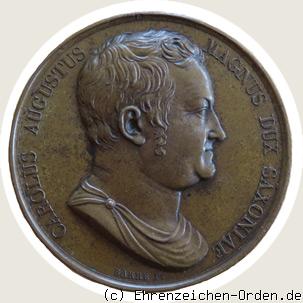 Front: Meritis Nobilis Bronze Medal of Merit
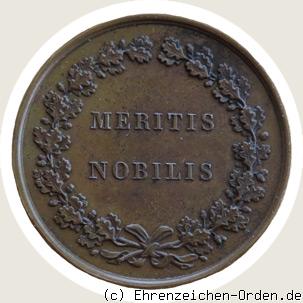 Reverse: Meritis Nobilis Bronze Medal of Merit
Established:
December 1828 Grand Duke Karl Friedrich
Data:
- Material: Bronze
- Size: 35mm
- Weight: about 13g
estimated collector price:
700 – 750 €

 Awards of World War II